loading...


In recent years, Artificial Intelligence (AI) has emerged as a transformative technology with applications spanning various sectors such as healthcare, finance, autonomous vehicles, and more. To meet the growing demands of AI algorithms, there has been a significant focus on advancing Very Large Scale Integration (VLSI) design techniques. VLSI design plays a crucial role in enabling the efficient implementation of AI algorithms, providing high-performance computing capabilities while minimizing power consumption.
.jpg.jpeg)
One of the key advancements in VLSI design for AI applications is the integration of AI accelerators within System-on-Chip (SoC) platforms. SoC integration enables the seamless incorporation of dedicated AI hardware alongside traditional computing components, facilitating efficient AI algorithm execution. This integration minimizes data movement and latency, resulting in faster processing and reduced power consumption.
To overcome the computational demands of AI algorithms, specialized hardware accelerators have gained prominence. These accelerators are designed to perform specific AI tasks, such as convolutional neural network (CNN) computations or matrix multiplications, with remarkable efficiency. VLSI design techniques have enabled the development of highly optimized hardware architectures, such as Field-Programmable Gate Arrays (FPGAs), Graphics Processing Units (GPUs), and Application-Specific Integrated Circuits (ASICs), which deliver substantial performance improvements over traditional processors.
Efficient memory management is important in AI applications due to the large volumes of data involved. VLSI design has made significant strides in optimizing memory hierarchies, enabling faster access to data and reducing energy consumption. Techniques such as data compression, on-chip memory hierarchy design, and memory access optimizations have contributed to minimizing the memory bottleneck and improving overall system performance.
AI applications often operate on battery-powered devices, making power efficiency a crucial consideration in VLSI design. Various low-power design techniques have emerged, including voltage scaling, clock gating, power gating, and dynamic voltage and frequency scaling (DVFS). These techniques reduce power consumption during idle periods or by dynamically adjusting the voltage and frequency based on the workload, improving energy efficiency without sacrificing performance.
Inspired by the human brain's neural networks, neuromorphic architectures have gained attention in AI VLSI design. These architectures leverage the concept of spiking neural networks and event-driven processing to achieve energy-efficient and highly parallel computations. Neuromorphic VLSI designs aim to mimic the brain's synaptic connections, facilitating faster and more power-efficient AI computations.
Another intriguing area of research in VLSI design for AI applications is approximate computing. AI algorithms often exhibit resilience to slight deviations in their computations, allowing for trade-offs between accuracy and performance. By leveraging this characteristic, VLSI designers can develop approximate computing units that provide significant speed and power improvements compared to conventional computing units.
The complexity of VLSI design for AI applications necessitates the use of advanced design automation tools. These tools aid designers in optimizing critical parameters, such as power, performance, and area, while reducing design time. They enable high-level synthesis, system-level modeling, and automated layout generation, empowering designers to efficiently explore design trade-offs and achieve optimal VLSI implementations for AI algorithms.
The rapid growth of AI applications has fueled advancements in VLSI design, enabling the efficient implementation of AI algorithms with improved performance and power efficiency. Low-power design techniques, neuromorphic architectures, approximate computing, and design automation tools have further pushed the boundaries of VLSI design, enabling faster and more energy-efficient AI computations.
As the demand for AI continues to rise across various industries, the field of VLSI design will continue to evolve, driving further innovations and breakthroughs. The integration of AI-specific hardware and the development of specialized architectures will play a pivotal role in enabling AI algorithms to be deployed efficiently on a wide range of devices, from edge devices to data centers.
The advances in VLSI design for AI applications hold immense potential to revolutionize the way we process and implement artificial intelligence. These advancements not only enhance the performance and energy efficiency of AI algorithms but also pave the way for the development of more intelligent and capable systems that can seamlessly integrate AI into our daily lives.
For a comprehensive VLSI training online, contact FutureWiz!
 Advances in VLSI Design for Artificial Intelligence Applications
 Choosing the Right VLSI Training Institute: Factors to Consider
 VLSI Design for Energy-Efficient Wireless Sensor Networks
 How to Become a VLSI Chip Designer: A Beginner's Roadmap for 2026
 A to Z on India, Japan & the Future of Semiconductor Industry: A New Chapter in Tech Collaboration
 RTL Design vs Physical Design: What's the Real Difference?
 The Future of the Semiconductor Industry: What Indian Students Should Know
 Top 7 Career Paths After Completing a VLSI Course
 Best Time Management Tips for Students Preparing for VLSI Careers
 Mastering VLSI Physical Design: A Comprehensive Course Overview
 The Complete FPGA and ASIC Guide
 Verilog Essentials: Mastering the Fundamentals of Hardware Description Language
 Unleashing the Power of System Verilog: A Comprehensive Guide for Aspiring Designers
 Demystifying VLSI chip Design: Exploring the Core Concepts of VLSI Courses
 Basics of VLSI - An Ultimate Guide
 Career Prospects After Completing A VLSI Course
 Top 5 Reasons To Take Up A Professional VLSI Course
 Mastering VLSI Design: A Comprehensive Guide To Understanding Complex Integrated Circuits
 Future-Proof Your Career With A VLSI Course: How Learning About Integrated Circuits Can Boost Your Job Prospects?
 System Verilog: An Overview
 Introduction to Hardware Description Language (HDL)
 Unlock The Potential Of VLSI Design With An Integrated VLSI Course Online
 Universal Verification Methodology:An Efficient Verification Approach
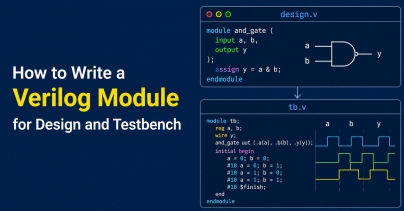 How to Write a Verilog Module for Design and Testbench